

The short answer. Tennessee doesn’t give grandparents an automatic right to visit. As the law reads, a grandparent can ask a court for visitation only in certain situations, for example when one of the child’s parents has died, when the parents are divorced, legally separated or were never married, or when a parent has been missing for six months or more. Generally, the parent must also have opposed visits or “severely reduced” them to no contact or token visits. Then the grandparent has to show the child would be in danger of substantial harm without the relationship, and that visits are in the child’s best interest. Whether your situation fits depends on your facts, so talk with me about your specific situation.
I’m Brenda Clark, a Nashville family lawyer licensed in Tennessee since 1983. I handle grandparent-visitation, custody and parenting-plan cases in Davidson, Williamson, Sumner and Wilson counties.
Do grandparents have “rights” in Tennessee?
Not automatic ones. People search for “grandparents’ rights”, but what Tennessee’s law gives a grandparent is the chance to ask a court for visitation, in situations the law lists, and only after the parent has opposed the visits or cut them back to almost nothing (T.C.A. § 36-6-306).
The law starts by respecting a parent’s decisions about who their child sees. That’s why the grandparent carries the burden: it isn’t enough to show that visits would be good for the child. You’d generally have to show that losing the relationship puts the child in danger of real harm. It’s a high bar, and I’d rather tell you that honestly at the start.
Which situations can qualify?
As the law reads, there are six. Each needs something more on top of it, so this table is a first look, not an answer (§ 36-6-306(a)).
| Your situation | What the law says, generally | What you’d still have to show |
|---|---|---|
| One of your grandchild’s parents has died | It’s one of the listed situations. If the parent who died was your son or daughter, the law presumes the child would be substantially harmed by losing you. | That the visits were opposed or severely reduced, that visits are in the child’s best interest, and the presumption can be challenged |
| The parents are divorced, legally separated, or were never married to each other | It’s one of the listed situations. | Opposition or severe reduction, danger of substantial harm, and best interest |
| A parent has been missing for six months or more | It’s one of the listed situations. | Opposition or severe reduction, danger of substantial harm, and best interest |
| A court in another state has already ordered grandparent visitation | It’s one of the listed situations. | Opposition or severe reduction, danger of substantial harm, and best interest |
| Your grandchild lived with you for 12 months or more, and a parent or custodian then took the child away | It’s one of the listed situations, and the law presumes that losing you may cause the child irreparable harm. | Opposition or severe reduction and best interest; the presumption can be challenged |
| You had a significant relationship with your grandchild for at least 12 months, and the parent cut it off or cut it back for a reason other than abuse or danger to the child | It’s one of the listed situations, where losing the relationship is likely to cause the child substantial emotional harm. | That the relationship was significant, why it ended, the likely harm, and best interest |
If your family doesn’t fit any of these, the law generally doesn’t let a grandparent ask. If you’re not sure, that’s exactly what a consultation is for. Talk with me about your specific situation.
What does “opposed or severely reduced” mean?
As the law reads, the court holds a hearing on a grandparent’s petition when the parent or custodian has opposed visits, or has “severely reduced” them. The law defines a severe reduction as a reduction “to no contact or token visitation”, using the meaning of “token visitation” found in another part of Tennessee’s law (§ 36-6-306(f); § 36-1-102).
In everyday terms: a parent who still lets you see your grandchild regularly, even less than you’d like, generally hasn’t “severely reduced” the visits. A parent who has stopped them, or allows only rare, brief visits, may have. Where your family’s visits fall on that line depends on the facts, so talk with me about your specific situation.
What would I have to prove?
Generally, two things, in order.
First: a danger of substantial harm to your grandchild if the relationship is lost (§ 36-6-306(b)). As the law reads, the court can find that danger where:
- the child had such a significant relationship with you that losing it is likely to cause the child severe emotional harm;
- you were one of the child’s primary caregivers, so losing you could interrupt the child’s daily care; or
- losing a significant relationship with you would put the child in danger of some other direct and substantial harm.
The law treats a relationship as “significant” if, for example, the child lived with you for at least six months in a row, you were the child’s full-time caretaker for at least six months in a row, or you had frequent visits for at least a year. You don’t necessarily need an expert to show it; the court looks at whether the facts would lead a reasonable person to believe it. And, as above, there are two presumptions: if the parent who died was your son or daughter, the law presumes substantial harm; and if the child lived with you for 12 months or more and was then taken away, it presumes irreparable harm. A presumption can be challenged.
Then: that visits are in your grandchild’s best interest. As the law reads, the court weighs factors including (§ 36-6-307):
- how long and how close your relationship with the child has been, and your role in the child’s life
- the child’s emotional ties to you, and the child’s own preference, if the child is mature enough to have one
- any hostility between you and the parent in front of the child, and whether you support the child’s relationship with the parents
- whether you’re asking in good faith
- if the parents are divorced or separated, the time-sharing they already have
- if a parent has died or is missing, whether you’re that parent’s mother or father
- whether the parent has unreasonably kept the child from you, for example for more than 90 days
- whether visits would interfere with the parent-child relationship
- any court finding that the parent is unfit
If the court orders visits, what does that look like? Since a 2024 change to the law, reasonable visitation must be, “at a minimum, sufficient contact to reasonably permit a strong and meaningful relationship” with the child, for petitions filed on or after the date the change took effect (2024 Pub. Ch. 715, amending § 36-6-306(c)). What that means in hours and days for your family is up to the court, case by case.
What should I keep a record of?
Start now, and write it down at the time, because you can’t go back later and create what happened.
- Your history with your grandchild: the dates you saw them, how often and for how long, overnights, holidays, and anything you did for their day-to-day care
- If they lived with you: when they moved in, when they left, and who took them
- What changed, and when: the last normal visit, the first refusal, and any messages about it (keep them; don’t delete anything)
- What you’ve tried: calls, letters and offers to visit, with the dates and the answers
- Small things that show the bond: cards, photos, school and church events, birthday parties
Keep it calm and factual. A record written in anger can hurt more than it helps.
Can we work it out without court?
Often it’s worth trying first. A calm, short written request to the parent, offering a visit on their terms and at their pace, keeps the door open. Don’t show up uninvited, post about it, or run the parent down to the child; besides being hard on your grandchild, hostility in front of the child is one of the things a court weighs.
If the two of you are willing to sit down together, I also offer family mediation at nashvillefamilymediator.com. It only works if everyone comes willingly. Where there’s an order of protection, or a court finding or conviction of domestic abuse, Tennessee’s law on visitation cases allows mediation only if the person who was abused agrees, with a mediator trained in domestic and family violence, and with a support person there if they want one (§ 36-6-305).
Where is the case filed, and what happens?
A grandparent asks by filing a petition with a court. As the law reads, once the parent has opposed or severely reduced the visits and one of the listed situations applies, the court holds a hearing. At the hearing, the court first decides whether there’s a danger of substantial harm, and only then looks at the child’s best interest (§ 36-6-306).
Which court hears it, and in which county, depends on where your grandchild lives and whether a court already has a case about the child, for example the parents’ divorce or a custody case. Talk with me about your specific situation. I take cases in Davidson, Williamson, Sumner and Wilson counties.
The court can also order either side to pay the other’s reasonable attorney fees and costs, as the law reads (§ 36-6-306(g)). Whether it would in your case is up to the court.
My grandchild’s parents are still together. Can I still ask?
Generally, it’s much harder. Most of the listed situations are about a family that has changed: a death, a divorce or separation, parents who never married, a missing parent. One of them, as the law reads, is different: a significant relationship of at least 12 months that the parent cut off, or cut back, for a reason other than abuse or danger to the child, where losing it is likely to cause the child substantial emotional harm. Whether that can fit a family where the parents are still together depends on the facts, and it’s a hard case to make. Talk with me about your specific situation before you decide anything.
What about custody, not just visits?
That’s a different question, and a harder one. Asking to raise your grandchild, rather than to visit, means asking a court to place a child away from a parent. The rules for that aren’t the ones on this page, and courts give a parent’s custody strong protection. If you’re worried about where your grandchild is living, or you’re already caring for them, talk with me about your specific situation as soon as you can.
I’m worried my grandchild isn’t safe.
Your grandchild’s safety comes before any of this. If a child is in danger, call 911. If your son or daughter is being hurt by a partner, the National Domestic Violence Hotline is free and confidential, day and night: 1-800-799-7233, or text START to 88788. When you’re ready, call me at (615) 649-6841. A worry about a child’s safety is a different matter from visitation, and the steps are different, so tell me about it first. Safety, on the children’s page
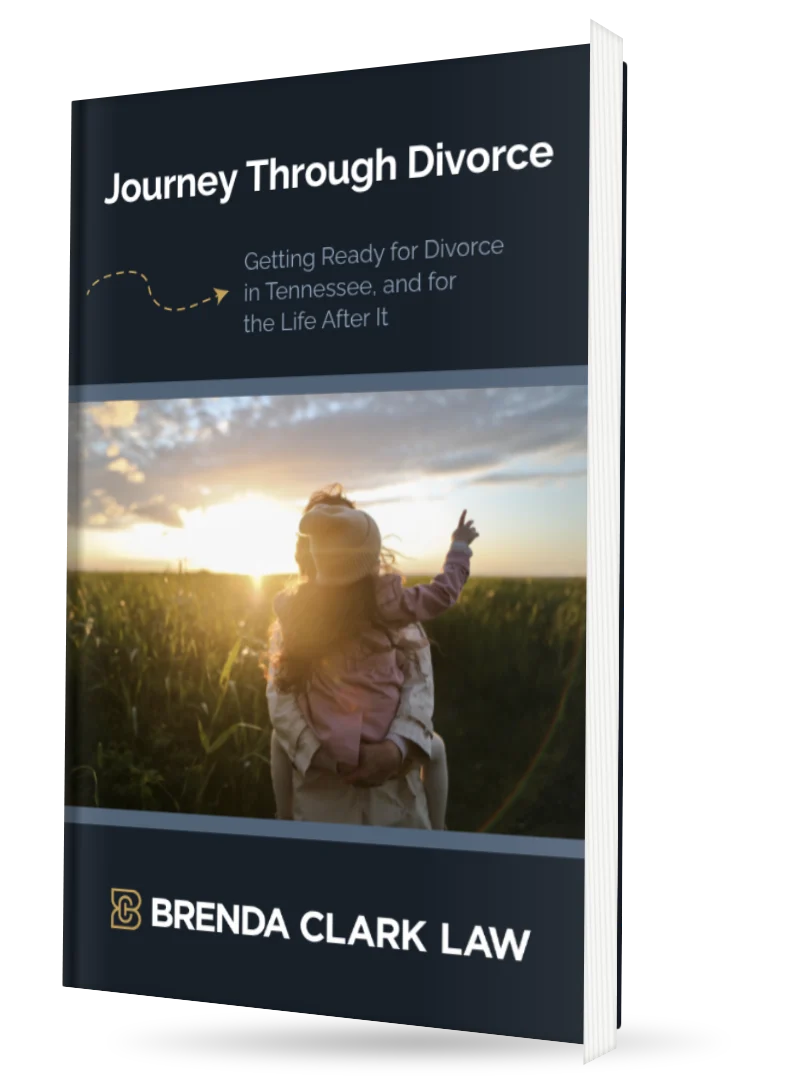
Want a place to keep your record? Get Journey Through Divorce.
It’s written for parents going through a divorce, so most of it isn’t about you. But its children’s chapter explains what Tennessee courts weigh for a child’s best interest, and its journal pages are a good way to keep the record this page describes.
- What Tennessee courts weigh for a child’s best interest, in everyday words
- A journal to keep for a child, written at the time
- A conversation log, for keeping track of what was said and when
- How to help children of every age through a change in their family
It comes straight to your inbox. Free, and you can unsubscribe any time.
If you can’t receive or download this guide safely, or are concerned about your spouse seeing it, please call me directly at 615-649-6841.
“Brenda is a wonderful lawyer! Kind, compassionate, empathetic, understanding, knowledgeable, fair, and a trusted legal advisor. I’m very grateful she was my guide through an extremely difficult experience.”
Reviews describe one person’s experience. Every case is different. Past results don’t guarantee a future outcome. Read more reviews
- Licensed in Tennessee since 1983. Board of Professional Responsibility record
- Family law in Davidson, Williamson, Sumner and Wilson counties, including custody, parenting plans and grandparent visitation.
Questions grandparents ask
Does “grandparent” include great-grandparents or step-grandparents?
As the law reads, it can include great-grandparents, the spouse of a grandparent, and the parents of an adoptive parent (§ 36-6-306(e)). If your place in the family is less clear, ask me.
What happens if my grandchild is adopted?
As the law reads, grandparent visitation generally ends if the child is adopted by someone who isn’t a relative or stepparent, while if a relative or stepparent adopts, the grandparent-visitation law still applies (§ 36-6-306(d)). If an adoption is coming, talk with me right away.
Does it matter which side of the family I’m on?
It can. If a parent has died or is missing, whether you’re that parent’s mother or father is one of the best-interest factors, and if the parent who died was your son or daughter, the law presumes substantial harm. Grandparents on either side can ask in the other listed situations.
How long do I have to wait before I ask?
As the law reads, there’s no single waiting period, but some situations have their own: six months for a missing parent, 12 months for a child who lived with you or a relationship that was cut off. A parent unreasonably keeping the child from you, for example for more than 90 days, is one of the best-interest factors. Don’t wait long to get advice.
Can I talk to you before I’ve decided anything?
Yes. What you tell me in a consultation is kept confidential, even if you never hire me.
Is the first consultation free?
Yes, at my Nashville office or by phone or video. I take cases in Davidson, Williamson, Sumner and Wilson counties, and work with people in Spring Hill too. Schedule it here